
Table of Contents
- Introduction
- What a Normal Insect Bite Looks Like
- How to Recognise an Infected Insect Bite
- Normal Bite vs Infected Bite: Quick Comparison
- Infected Insect Bite Treatment Options
- Benefits of Getting Treatment Early
- Common Use Cases
- Best Practices for Bite Care
- Common Mistakes to Avoid
- Frequently Asked Questions
- Conclusion
Introduction
Most insect bites settle within a few days. There is some itching, a small raised bump, and mild swelling, and then it fades. But sometimes a bite goes wrong. Bacteria can enter the broken skin, often after someone scratches it, and the area starts to hurt, heat up, and spread redness. That is when infected insect bite treatment becomes important. Knowing the difference between a bite that is healing and one that needs help can spare you a lot of discomfort and, in rare cases, a serious complication.
This guide explains what an infected bite looks like, what you can do at home, and when to speak to a pharmacist or GP. If you live in or around Chertsey, the team at Chertsey Pharmacy can look at a bite quickly, and in England you can often get advice without waiting for a GP appointment.
What a Normal Insect Bite Looks Like
Before you can spot a problem, it helps to know what a normal bite does. Mosquitoes, midges, fleas, bed bugs, horseflies, and gnats all leave slightly different marks, but the typical reaction follows a similar pattern.
The Usual Reaction
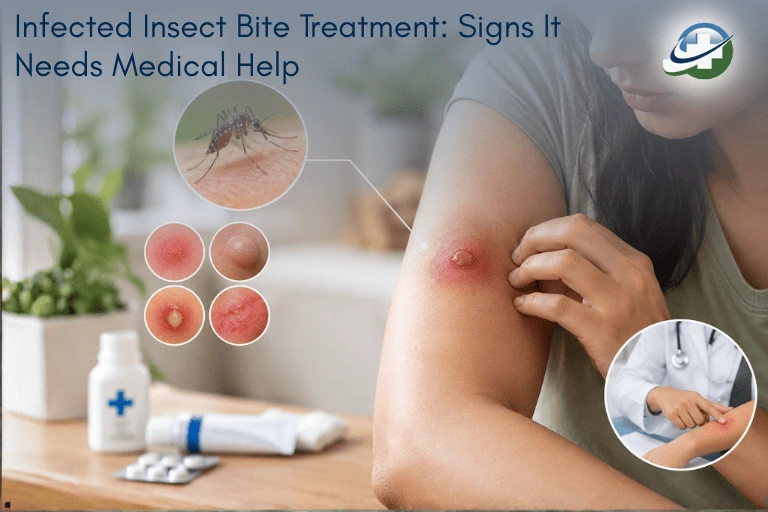
A healthy bite tends to produce a small, raised, pink or red bump that itches. It may feel warm for a short time and can look a bit puffy around the centre. The reaction usually peaks within the first day or two and then gradually shrinks. Most people find that it is clearly improving within three to four days and has largely gone within about a week.
Why Some Bites Get Worse
Your body’s reaction to a bite is partly an immune response, which is why some people react much more strongly than others. Reactions can also get worse when the bite is scratched. Broken skin gives bacteria an easy route in, and that is when a simple bite can start to turn into an infection.
Bites That Are Slow to Heal
Some bites take longer to settle, particularly horsefly bites and bites on the lower legs. Slow healing on its own is not always a sign of infection. What matters is the direction the bite is heading. If it is getting bigger, more painful, or more inflamed after a few days rather than less, it is time to take a closer look.
How to Recognise an Infected Insect Bite
An infected bite usually gets worse, not better, over time. The pain increases, the skin around the bite changes, and you may start to feel generally unwell. The signs below are the ones that matter most.
Early Warning Signs
The first changes are often subtle. You might notice that the area is more tender than it was yesterday, or that it feels hot when you touch it. The skin may look redder than the rest of your skin, and the swelling may be spreading outwards instead of staying in one spot. Redness can be harder to see on brown and black skin, so it is worth checking by touch as well as by sight. Warmth and tenderness are often the first clues.
Signs That Need Medical Help Sooner
Some symptoms mean you should speak to a healthcare professional the same day. These include:
- Pain or tenderness that is getting worse rather than better
- Skin that feels hot and looks red, and the redness is spreading
- Swelling that keeps growing or feels tight
- Pus, a yellow or cloudy discharge, or a crust forming over the bite
- A bite on the face, around the eyes, or on a hand or foot, where infections can progress quickly
- A bite that has been scratched open and is not improving after a few days of home care
Signs That Need Urgent Help
Some symptoms are more serious and mean you should not wait. If you develop a fever, chills, a racing heartbeat, rapid breathing, confusion, or you simply feel very unwell, call 999 or go to A&E. The same applies if you see red streaks spreading away from the bite, as this can be a sign that the infection is moving through the body.
A different and more urgent situation is a severe allergic reaction. If you notice swelling of the face, lips, tongue, or throat, difficulty breathing, dizziness, or a sudden feeling of faintness after a bite or sting, call 999 straight away. If you have ever had a serious allergic reaction to an insect bite or sting before, you should seek urgent help from the start, even if the bite looks minor.
Normal Bite vs Infected Bite: Quick Comparison
The table below gives a simple side-by-side view. Use it as a quick check, not a substitute for advice if you are unsure.
| Feature | Normal Bite | Infected Bite |
| Pain | Mild, mostly itching | Increasing pain or tenderness |
| Swelling | Small, stays in one area | Growing, spreading, or feels tight |
| Skin temperature | Normal or slightly warm for a short time | Hot to the touch |
| Redness | Pink or light red, fading over days | Deep or spreading redness |
| Discharge | None | Pus, yellow or cloudy fluid, or a crust |
| Timeline | Improving within 3 to 4 days | Getting worse after 2 to 3 days |
| General health | You feel normal | Fever, chills, or feeling unwell |
| Action | Home care and monitoring | Speak to a pharmacist or GP |
If your bite fits the right-hand column, do not wait for it to clear up on its own.
Infected Insect Bite Treatment Options
Treatment depends on how serious the infection is. Mild cases can often be managed at home for a short time, while more significant infections need a prescription and a proper assessment. The steps below cover both.
Home Care First
If a bite is itchy but not showing signs of infection, start with simple care. Wash the area gently with soap and water, and if you have an antiseptic, apply it according to the label. Try not to scratch. Scratching breaks the skin and is the most common reason a bite becomes infected in the first place.
Keep the area clean and dry. Covering it with a loose dressing can help stop you touching it, particularly if you have children who keep picking at the spot. A cold compress can ease swelling and itching for short periods, as long as you wrap it in a cloth and do not hold it directly on the skin.
Home care is for early, mild symptoms only. If the bite is clearly getting worse, you should move on to getting professional advice.
When a Pharmacist Can Help
A pharmacist is often the quickest route to proper help. In England, the NHS Pharmacy First service allows pharmacists to assess and treat infected insect bites without a GP appointment, for people aged one year and over. The pharmacist can look at the bite, ask about your symptoms, check whether anything else might be going on, and recommend an appropriate treatment. If the infection needs more than pharmacy care, they can refer you on.
At Chertsey Pharmacy, you can contact the team to talk through a bite and find out whether it needs a same-day assessment. You can read more about the service on our Infected Skin Bites page, and if you are also dealing with a skin infection that spreads from scratching, our Impetigo guide explains how it differs.
When to See a GP or Call 111
Some situations need a GP. A child under one year old with an insect bite should be seen by a GP rather than a pharmacist. You should also see a GP if the infection is not improving after pharmacy treatment, if it is severe, or if you have a health condition that makes infections harder to fight off, such as a weakened immune system or diabetes. If you cannot reach a GP quickly and the symptoms are worrying, the NHS 111 service can help you decide what to do next.
Treatment for an infected bite, when prescribed, is usually a short course. It is important to finish the course exactly as directed and to get checked again if the symptoms return.
Tetanus and Wound Care
Most insect bites do not require tetanus protection, but if a bite has broken the skin deeply, or if you are not sure when you last had a tetanus booster, ask a pharmacist or GP to check. Our Diphtheria, Tetanus and Polio vaccine page explains the vaccine and who it is for. Keeping your vaccinations up to date is one of the simplest ways to stay protected when you are outdoors.
Benefits of Getting Treatment Early
Acting early on an infected bite has clear advantages. The most obvious one is comfort. Pain, heat, and swelling are unpleasant, and they tend to settle faster when the infection is caught early. Early treatment also reduces the chance that the infection will spread into the surrounding tissue, which can turn a small problem into a much bigger one.
There is also a practical benefit. A quick assessment at a pharmacy can save you a long wait for a GP appointment and a trip to A&E. In England, Pharmacy First means you can often be seen the same day, which is useful when you are on holiday, at work, or looking after children.
Finally, early treatment gives you peace of mind. Many people spend days wondering whether a bite is normal. A short conversation with a pharmacist can settle that question, and you will know exactly what to watch for next.
Common Use Cases
Infected insect bites show up in a range of everyday situations. Here are some of the most common ones.
Bites From Summer Insects
Warmer months bring more mosquitoes, midges, horseflies, and wasps. Pharmacy teams often see a spike in consultations during the summer, which is why it helps to know the warning signs before you need them. A bite from a horsefly, for example, can take longer to heal and is more likely to become infected if it is scratched.
Bites in Children
Children are more likely to scratch bites, and they often do not tell you when something hurts. Check their bites each day, especially if they are scratching at one spot, or if they seem unusually tender, irritable, or less active than normal. A child under one year old should always be seen by a GP for an insect bite.
Bites on the Face or Near the Eyes
Bites around the face, eyes, lips, or ears can swell quickly and look alarming. Because infections in these areas can progress faster, it is worth getting advice early, even if the bite looks small. Swelling that affects the eye itself, or that makes it hard to open the eye, should be checked the same day.
Bites After Travel
Bites picked up abroad can sometimes be harder to assess, particularly if you are not sure what bit you. If you have returned from a trip and a bite is getting worse, mention where you travelled. A pharmacist or GP can look at it and advise you on the next steps. If you are planning a trip, our NHS Services page and the Walk-in Services page list the support available.
Best Practices for Bite Care
Good bite care is mostly about avoiding trouble in the first place, and then acting quickly when something goes wrong.
Start by washing your hands before and after touching a bite. This reduces the bacteria that can reach broken skin. Clean the bite gently with soap and water, and pat it dry rather than rubbing.
Resist the urge to scratch. This is the most important habit to build. If the bite is driving you mad, try a cold compress, a cool cloth, or a loose dressing to keep your hands away from it. Trimming children’s nails short can also help.
Check the bite every day. Take a quick note of its size and colour, or take a photo, so you can compare. This makes it much easier to tell whether the bite is improving or getting worse, and it gives a pharmacist or GP useful information if you need to speak to them.
Protect yourself from new bites. Use insect repellent when you are outdoors, wear long sleeves and trousers in areas with lots of insects, and keep windows and doors screened where possible. Prevention is the easiest way to avoid infected bites altogether.
Keep an eye on your general health too. If you feel feverish, unwell, or unusually tired while a bite is still bothering you, do not wait for it to settle. Get it checked.
Common Mistakes to Avoid
Most infected bites happen because of a few avoidable habits. Here are the mistakes that come up most often.
Scratching the bite until it breaks. This is the single biggest cause of infection. Once the skin is open, bacteria can get in easily. Even if the bite is very itchy, try to leave it alone.
Squeezing or popping the bite. Squeezing pushes bacteria deeper into the skin and can make the infection worse. If the bite has a spot of pus, speak to a pharmacist rather than trying to drain it yourself.
Waiting too long to get help. Many people hope a bite will clear up on its own, and sometimes it does. But if the symptoms are getting worse after two to three days, it is better to get advice than to wait another week.
Ignoring the warning signs. Heat, spreading redness, and a fever are not things to dismiss. If you notice any of them, speak to a healthcare professional the same day.
Using the wrong treatment on a bite. Some people apply products from the back of the cupboard without checking whether they are suitable. Always read the label and ask a pharmacist if you are unsure what is right for the bite or for your age.
Assuming a small bite cannot be serious. A bite on the face, hands, or feet can become serious quickly. Size is not always a reliable guide, so trust your judgement if the bite looks like it is getting worse.
Forgetting about allergic reactions. Swelling of the lips or throat, difficulty breathing, or feeling faint after a bite is an emergency. Call 999 straight away.
Frequently Asked Questions
How do I know if an insect bite is infected?
An infected insect bite usually becomes more painful, hot, and swollen over time, rather than improving. You may see spreading redness, pus, or a crust forming over the bite. If you also have a fever or feel generally unwell, speak to a pharmacist or GP the same day.
Can I treat an infected insect bite at home?
You can look after a mild bite at home by keeping it clean, avoiding scratching, and using a cold compress for comfort. If it shows signs of infection, such as increasing pain, heat, spreading redness, or pus, it needs assessment from a pharmacist or GP. Home care alone is not enough for an established infection.
How long does an infected insect bite take to heal?
With appropriate treatment, most infected bites start to improve within a few days. Full healing can take a week or more, depending on how deep the infection is and how the bite was managed. If there is no improvement after two to three days of treatment, go back to your pharmacist or GP.
Do I need to see a GP for an infected insect bite?
Not always. In England, a pharmacist can assess and treat many infected insect bites through the Pharmacy First service, for people aged one year and over. A GP is the right choice for a child under one year old, for infections that are not improving, for severe infections, or where there are other health concerns.
When should I go to A&E?
Go to A&E or call 999 if you have difficulty breathing, swelling of the face, lips, or throat, a severe allergic reaction, a high fever with chills, confusion, a racing heartbeat, or red streaks spreading from the bite. These can be signs of a serious reaction or a spreading infection that needs urgent care.
Are insect bites ever dangerous?
Most insect bites are harmless and get better on their own. However, an untreated infection can spread, and a severe allergic reaction can be life-threatening. That is why it is important to recognise the warning signs and act quickly.
Can children get infected insect bites?
Yes. Children often scratch their bites, which makes infection more likely. Check their bites daily, and see a GP for any insect bite in a child under one year old. Older children with an infected bite can usually be assessed by a pharmacist.
Does a tetanus jab help with insect bites?
Most insect bites do not need tetanus protection. If a bite has broken the skin deeply or you are unsure of your vaccination history, ask a pharmacist or GP to check whether a booster is needed.
Conclusion
Most insect bites are a minor annoyance that clears up without fuss. But when a bite becomes hot, painful, swollen, or starts to spread, it needs proper attention. Keeping the area clean, avoiding scratching, and watching for the warning signs will handle most situations. When the symptoms point to an infection, a pharmacist or GP can assess it and recommend the right next step. Emergency symptoms, such as trouble breathing, facial swelling, a high fever, or red streaks from the bite, need an immediate call to 999.
If you are in or around Chertsey and a bite is worrying you, do not wait it out. Speak to the team at Chertsey Pharmacy. You can contact us with your questions, or book an appointment so a pharmacist can look at the bite and advise you on the right treatment for your situation. Early advice is the simplest way to get back to feeling comfortable again.
For more information on the signs of infection, see the NHS guidance on insect bites and stings.